
Smart membrane versus vapour barrier
Published on 17.09.2026 · Isoflect Insulation technical team
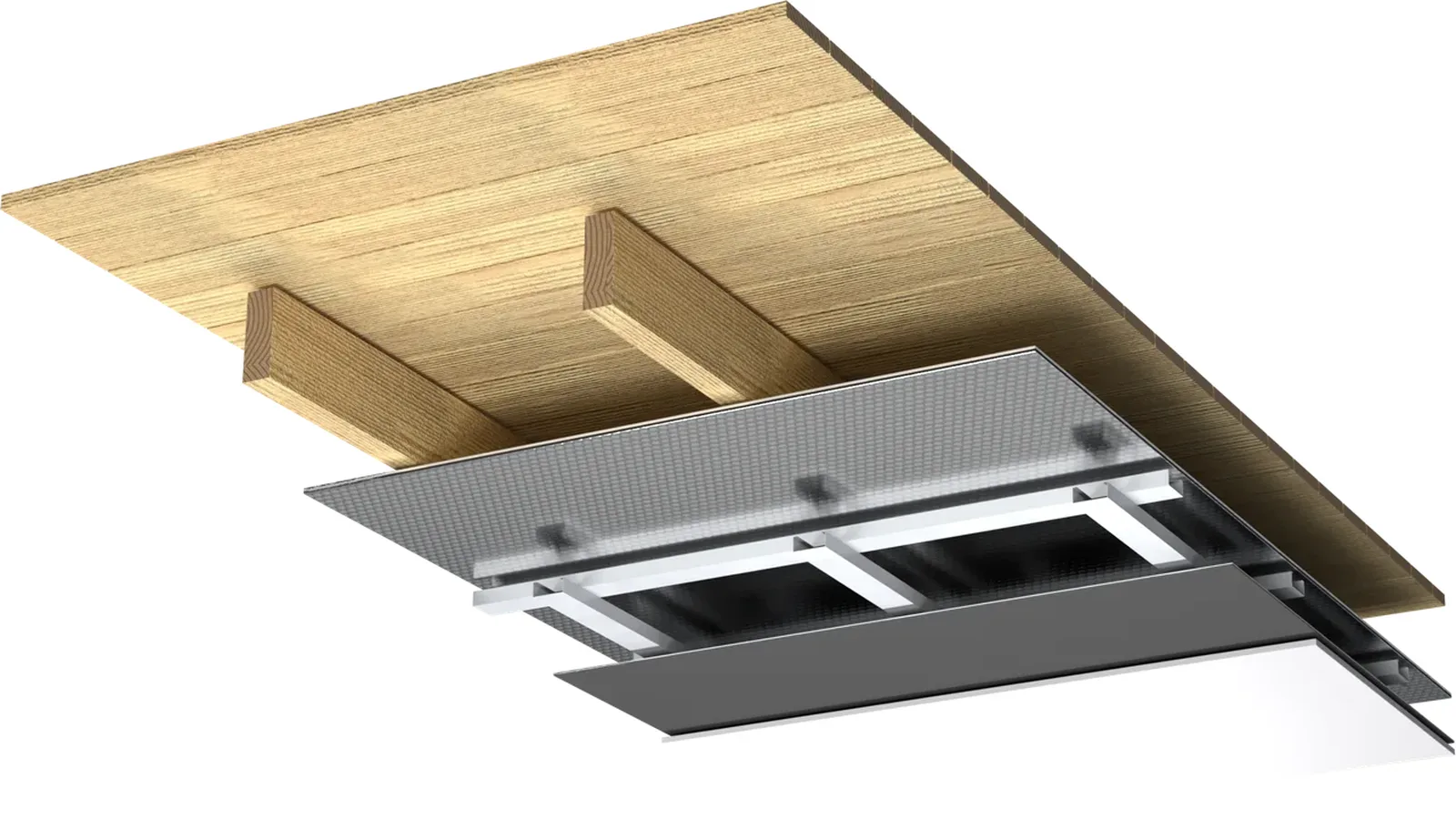
A habitable attic may look impeccable at the end of a renovation and yet conceal a problem that appears only after a few winters: damp insulation, stains on finishes or timber affected by condensation. In the choice between a smart membrane and a vapour barrier, the difference is not merely a matter of name or price per square metre. It determines how the wall or roof manages the water vapour produced daily in the home.
A bathroom used in the morning, cooking, drying laundry and simple breathing all increase indoor air humidity. Vapour tends to migrate towards the colder areas of the building envelope. If it reaches the mineral wool layer, the roof timber or the space behind the plasterboard and turns into water, thermal efficiency decreases and the risk of mould and deterioration increases.
The correct choice is not universal. It depends on the type of construction, the position of the insulation, the capacity of the external layers to diffuse vapour and the discipline of installation. A high-performance membrane installed without airtight sealing may lose much of its effect, since warm air carries far more moisture through gaps than slow diffusion through materials does.
Smart membrane versus vapour barrier: the real difference
A conventional vapour barrier has a very high and constant resistance to the passage of vapour. Its role is to limit the ingress of moisture from the interior into the insulation. It is generally installed on the warm side of the thermal insulation, facing the interior of the room. If it is selected and sealed correctly, it can be a reliable solution for certain build-ups.
A smart membrane has variable vapour permeability. In the cold season, when the indoor air is more humid and the exterior is cold, the membrane offers greater resistance, protecting the insulation from vapour loading. In warm periods, when the structure needs to release accidentally accumulated moisture, its resistance may decrease. The system thereby acquires a capacity to dry towards the interior.
This variation is expressed by the Sd value, the equivalent thickness of an air layer offering the same resistance to vapour diffusion. A conventional barrier usually has a high and stable Sd. A humidity-variable membrane operates within a range of Sd values, adapted to humidity conditions. This is not a theoretical detail: in timber roofs and renovated habitable attics, drying capacity can reduce the risk of a small amount of moisture remaining trapped in the structure for years.
When a vapour barrier is appropriate
A vapour barrier may be the efficient choice in new construction, with correctly designed external layers and controlled installation. For example, in a ventilated roof with a diffusion membrane on the exterior, a functional ventilation space beneath the roof covering and continuously installed thermal insulation, the interior vapour barrier can predictably limit the moisture input from the house.
It is also frequently used in areas where strong protection against vapour is sought, provided that the entire system is calculated for the situation in question. In spaces with high humidity, such as bathrooms, professional kitchens or certain plant rooms, the requirements become stricter. Here it is not sufficient to choose a membrane with a high Sd. Ventilation, the sealing of junctions and the correct position of all layers must be verified together.
The limitation of a conventional barrier becomes apparent when moisture nevertheless reaches the assembly. It may originate from local leaks, from timber installed with excessive moisture content, from unsealed gaps or from works carried out in wet weather. If the exterior has low vapour permeability and the interior is closed with a barrier that is highly diffusion-tight, drying becomes slow. In some renovations, this risk merits analysis before the solution is chosen.
Where a smart membrane adds value
A smart membrane is particularly useful in habitable attics, attics converted into heated spaces, timber-frame buildings and renovations where the existing build-up cannot be perfectly controlled. In these situations, old materials, the absence of a modern external membrane or hard-to-reach details may create uncertainties. A membrane with humidity-variable behaviour provides an additional safety margin through its capacity to allow drying towards the interior when conditions are favourable.
This does not mean that a smart membrane automatically corrects every mistake. It does not stop water coming from a damaged roof covering, nor does it replace the diffusion membrane installed beneath the roof covering. Nor can it compensate for a lack of ventilation in the bathroom or kitchen. Its role is to manage the vapour flow in a controlled manner within a correctly designed system.
For a habitable attic, the typical sequence of layers must be regarded as a system: interior finish, service cavity if provided, sealed membrane, thermal insulation between and below the rafters, external protection and diffusion layer, then ventilation and the roof covering. Each layer has a distinct function. Confusing the external anti-condensation membrane with the internal vapour barrier is one of the most costly installation errors.
Airtightness matters just as much
Both the vapour barrier and the smart membrane must function as an airtightness layer. Overlaps are bonded with compatible tape, and junctions with masonry, roof windows, chimneys, beams and service penetrations are treated with dedicated accessories. A perforation left unsealed around a cable or a pipe may become a direct route for warm, humid air towards the cold zone.
For this reason, a service cavity between the membrane and the finish is a very sound practical decision. Cables and electrical boxes can be installed in this layer without repeatedly perforating the membrane. The result is more reliable sealing, cleaner installation and more predictable long-term performance.
How to choose for your project
Before purchasing, check whether the roof or wall has a vapour-permeable external layer and whether there is correct ventilation beneath the roof covering. Then consider whether this is new construction, where the layers can be determined from scratch, or a renovation with many unknowns. The pattern of use also matters: a permanently occupied house, an intermittently heated cabin and a habitable attic with a bathroom have different moisture loads.
Choose a vapour barrier when the build-up is clear, the exterior allows moisture to escape and you are certain of airtight installation. Choose a smart membrane when you want a solution that is more tolerant of humidity variations and offers a useful capacity to dry towards the interior, particularly in timber structures or renovations. In both cases, do not evaluate the membrane in isolation. The compatibility of the bonding tapes, sleeves, adhesives and the substrate to which it is applied is essential.
Isoflect Insulation approaches these works as complete systems, not as mere rolls of membrane. For a reliable result, the configuration must take into account the surface area, the thickness of the thermal insulation, the type of roof structure, the position of services and the humidity level of the rooms.
A correctly chosen membrane protects more than the insulation. It protects the timber, the finishes, the investment in heating and the comfort you expect from your home. If you are uncertain between a smart membrane and a vapour barrier, start from the actual build-up of the construction, not from the solution used by a neighbour. It is the details of your structure that determine the reliable system.